What’s Attachment Got to Do With It?Why We React So Strongly When Relationships Matter

Someone takes longer than usual to reply, and suddenly you are no longer simply reading a message. You are reading into a silence.
A partner seems distracted, and your mind begins building a case: something is wrong; they are losing interest; you have done something; perhaps you should pull away before you look needy.
Or perhaps your response is the opposite. Someone wants more closeness, reassurance or emotional conversation, and you feel a sudden pressure to escape it. You become practical. Distant. Busy. You tell yourself you simply do not need much from anyone.
These reactions are often dismissed as overthinking, neediness, emotional unavailability or poor communication.
Sometimes they are better understood through attachment theory.
Not because every uncomfortable relationship moment can be traced neatly back to childhood. Not because people can be reduced to four tidy relationship types. And certainly not because our patterns are fixed forever.
Attachment theory is useful because it asks a deeper question:
What has your system learned to expect when connection becomes important?
Attachment is not your relationship personality type

Attachment theory emerged from the work of John Bowlby and Mary Ainsworth, who examined how early caregiving relationships shape a child’s expectations of safety, comfort and responsiveness (Ainsworth et al., 1978; Bowlby, 1969/1982).
In adulthood, attachment theory has developed into a broader framework for understanding how people manage emotional closeness, dependence, conflict, rejection and support in significant relationships.
Importantly, contemporary research does not support a simplistic view that early experiences determine adult relationship behaviour in a fixed or inevitable way.
Early relationships matter, but attachment patterns are also shaped by later relationships, major experiences and the meanings we make of them over time (Fraley, 2019; Fraley & Roisman, 2019; Fraley et al., 2021).
Rather than placing every person into one permanent category, much adult attachment research focuses on two dimensions:
Attachment anxiety: heightened concern about rejection, abandonment, inconsistency or not being enough.
Attachment avoidance: discomfort with dependence, vulnerability, emotional closeness or needing others.
Lower levels of both anxiety and avoidance are generally associated with greater attachment security: the capacity to be close without losing yourself, and to be independent without emotionally cutting yourself off (Brennan et al., 1998; Fraley, 2019).
This is a far more useful way to understand attachment than treating it as a personality label.
Someone may feel relatively secure in friendships yet become highly anxious in a romantic relationship. Someone may appear confident and independent professionally while struggling to tolerate emotional reliance at home. Someone may want connection intensely, then become distant as soon as it arrives.
Attachment is not a diagnosis. It is a pattern of expectation and protection that often becomes most visible when something important feels uncertain.
Why a delayed reply can feel bigger than a delayed reply

When a relationship matters, ambiguity rarely stays neutral for long.
A delayed reply may simply mean someone is busy. A change in tone may have little to do with you. A difficult conversation may be repairable.
But if distance, inconsistency or emotional withdrawal has previously carried significant meaning, the present moment may become loaded very quickly. Instead of experiencing uncertainty as uncertainty, your system may begin treating it as evidence.
Within attachment research, people higher in attachment anxiety are more likely to rely on hyperactivating strategies under relational stress: heightened monitoring of the other person, reassurance-seeking, intensified distress, rumination and difficulty disengaging from perceived signs of rejection (Mikulincer & Shaver, 2019).
Someone higher in attachment avoidance may rely more on deactivating strategies: minimising emotional need, suppressing distress, withdrawing, becoming overly self-reliant or deciding that the relationship matters less than it actually does (Mikulincer & Shaver, 2019).
Neither response automatically means someone is dramatic, cold, weak or incapable of a healthy relationship.
Both responses can be understood as attempts to manage emotional threat.
One strategy says: Move closer quickly, before I am left.
The other says: Create distance quickly, before I am overwhelmed, disappointed or exposed.
The difficulty is not that either strategy is always wrong. Sometimes reassurance is appropriate. Sometimes space is necessary.
The difficulty begins when one protective strategy becomes the only move available.
The part people often miss: attachment affects emotional regulation
Attachment is not only about who we date or how much reassurance we want. It is closely connected to what happens inside us when closeness becomes emotionally risky.

A 2023 systematic review of adult attachment and objective measures of emotion regulation found that secure attachment was consistently associated with more balanced emotion regulation, while insecure and unresolved attachment representations were associated with greater difficulties regulating emotional states (Eilert & Buchheim, 2023).
This becomes important in ordinary moments of relationship strain.
Can you notice anxiety without immediately acting on it?
Can you seek reassurance without feeling ashamed or desperate?
Can you take space without emotionally disappearing?
Can you stay open to another person’s perspective while still recognising that you feel hurt?
More recent research has extended this discussion by examining emotion-regulation flexibility: the ability to adapt how we regulate emotion depending on what a situation actually requires. Sometimes we need to soothe ourselves. Sometimes we need to speak openly. Sometimes we need support. Sometimes we need time before responding.
In a 2024 study of romantic relationships, higher attachment anxiety was associated with less flexible use of interpersonal emotion regulation depending on whether a partner was available, while higher attachment avoidance was associated with relying less on interpersonal regulation relative to self-directed strategies (Mosannenzadeh et al., 2024).
In other words, attachment insecurity may not simply affect how much emotion we feel. It may affect how freely we can respond to emotion.
Rather than choosing what is most helpful in the present moment, we may find ourselves falling automatically into an old protective pattern: chase, withdraw, suppress, explain, please, test, shut down or pretend not to care.
Attachment and the loss of perspective
One of the more interesting modern developments in psychotherapy research is the relationship between attachment and mentalising.
Mentalising is the capacity to understand our own and other people’s thoughts, feelings, motivations and intentions with a degree of openness and curiosity. It is what allows us to think:

Maybe they are tired.
Maybe I have misunderstood.
Maybe I am hurt, but that does not automatically mean I am being rejected.
Maybe this needs a conversation rather than a conclusion.
When we feel safe enough, this kind of perspective-taking is easier.
When attachment threat becomes intense, mentalising can narrow. We may become extremely certain about what someone else intends, even when we do not yet know. Or we may become so distressed that it becomes difficult to distinguish fear, memory and present-day evidence.
A 2025 study involving university students found that emotion regulation and mentalising helped explain the association between attachment insecurity and epistemic trust: the ability to experience communication from others as personally relevant, trustworthy and potentially useful (Karagiannopoulou et al., 2025).
This is a particularly valuable insight for everyday relationships.
Sometimes the difficulty is not that reassurance is never offered. It is that reassurance cannot easily be believed.
Someone says they care, but your mind searches for the hidden withdrawal.
Someone apologises, but your system remains on guard.
Someone offers feedback, but it feels more like rejection than information.
Someone tries to repair a rupture, but it feels safer not to let the repair matter.
You may want connection deeply, yet struggle to allow connection to settle your system.
The four attachment patterns, without turning yourself into a label
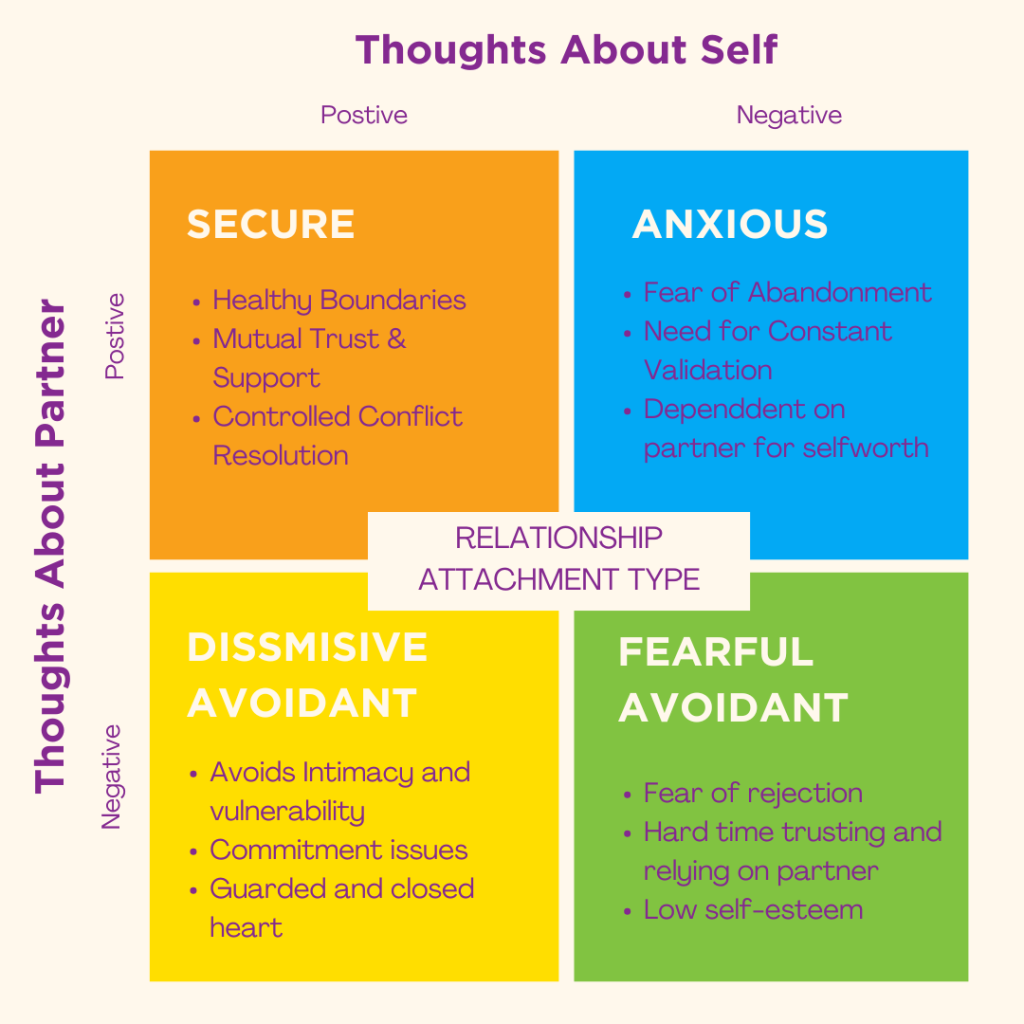
Attachment is often explained through four broad patterns. These can be useful as a map, provided they are not used as a diagnosis, an identity or a weapon against someone else.
Secure attachment
You are generally able to tolerate closeness and independence. Conflict may be uncomfortable, but it does not immediately become evidence that the relationship is collapsing. You can express needs, receive support and participate in repair after disconnection.
Anxious or preoccupied attachment
You may become particularly alert to distance, inconsistency or signs of reduced affection. You might seek reassurance, overanalyse communication, worry about being too much or feel unable to settle until connection feels restored.
Avoidant or dismissing attachment
You may value independence so strongly that emotional need feels exposing, demanding or unsafe. You might minimise distress, withdraw during conflict, become uncomfortable with dependence or interpret emotional closeness as pressure.
Fearful or disorganised patterns
You may long for connection while also experiencing it as unsafe, unpredictable or overwhelming. This can create a painful push-pull pattern: seeking closeness, then withdrawing from it; wanting reassurance, then mistrusting it when it arrives.
The four-category model has been influential in adult attachment research (Bartholomew & Horowitz, 1991). However, current research more commonly understands attachment through dimensions of anxiety and avoidance rather than assuming that every person fits neatly into one style (Brennan et al., 1998; Fraley, 2019).
This distinction matters.
A label can make people feel stuck but a pattern can be understood, observed and changed.
When an attachment pattern becomes more than a pattern
It is important not to confuse attachment insecurity with a personality disorder.
Many people become anxious, distant, defensive or emotionally reactive in particular relationships, especially during stress, grief, betrayal, major change or uncertainty. Attachment insecurity describes tendencies in the way we manage connection and threat. It is not, by itself, a clinical diagnosis.
However, for some people, relational threat can become so intense and persistent that it affects emotional stability, identity, trust and the capacity to understand what is happening in themselves and others.
Relationships may feel chronically unsafe or unstable. Closeness may be urgently desired and simultaneously difficult to tolerate. A moment of disconnection may trigger overwhelming distress, sharp shifts in perception or a powerful sense of rejection.
This is where attachment theory intersects with contemporary research on personality functioning, particularly borderline personality features.
A 2025 study examining attachment and borderline personality features found that attachment anxiety and avoidance were associated with borderline personality features partly through hypomentalising and epistemic mistrust: difficulty accurately reflecting on mental states and difficulty trusting socially communicated information (Kurt et al., 2025).
That finding does not mean that someone who fears abandonment, withdraws during conflict or overthinks a text message has a personality disorder.
It means that, when attachment distress becomes severe and pervasive, its effects may extend beyond dating patterns or communication difficulties. It may shape how a person experiences safety, identity, emotion and trust across relationships.
The clinically responsible question is not: What label applies to this person?
It is: How intense, rigid and life-limiting has this pattern become, and what kind of support might help?
Attachment can explain loneliness in people who are not alone

Loneliness is not always caused by a lack of people.
Someone can have friends, a partner, family, colleagues and regular contact with others, yet still struggle to feel emotionally safe, understood or genuinely connected.
A peer-reviewed 2022 study found that both anxious and avoidant attachment styles were positively associated with loneliness, with emotional intelligence partly explaining and shaping this relationship (Borawski et al., 2022).
This makes intuitive sense.
If you are constantly monitoring for evidence that someone will leave, connection may never feel safe enough to relax into.
If you protect yourself by remaining emotionally distant, connection may never become deep enough to feel sustaining.
Sometimes loneliness is not simply the absence of people. It is the absence of felt safety with people.
Questions worth asking yourself
Understanding attachment is not about diagnosing yourself after a difficult date or deciding that your partner is “avoidant” because they did not respond quickly enough.
It is about becoming curious about the patterns that appear when connection matters.
You might begin by asking:
What situations make me feel suddenly unsafe in connection?
Silence? Conflict? Needing support? Feeling criticised? Being misunderstood? Someone wanting more emotional closeness from me?
When I feel relational threat, what do I do first?
Do I move closer, move away, become highly rational, over-explain, shut down, seek certainty or pretend I am unaffected?
What story does my mind create in those moments?
They are leaving.
I am too much.
I cannot rely on anyone.
I will lose myself if I let someone in.
I need to fix this immediately.
What does my body do before my mind catches up?
Tight chest? Racing thoughts? Numbness? Urge to check? Irritation? Restlessness? Feeling suddenly trapped?
Does my response fit what is happening now, or does the intensity suggest that something older has been activated as well?
The purpose of these questions is not to shame the response.
Most protective responses developed because, at some point, they helped us manage uncertainty, disappointment, inconsistency or emotional pain.
The purpose is to create enough awareness that the pattern is no longer making every decision automatically.
Moving toward security is not about becoming less emotional

Attachment security is sometimes misunderstood as being unbothered, independent or easy-going at all times.
It is none of those things.
Security is not the absence of need. It is the ability to recognise need without being consumed by shame or fear.
It is the ability to experience distance without immediately assuming abandonment.
It is the ability to experience closeness without feeling that your autonomy is under threat.
It is the capacity to communicate discomfort, receive repair and remain connected to yourself while being connected to another person.
From a psychotherapy perspective, this is one reason the therapeutic relationship can matter so much. Therapy is not simply a place to intellectually discuss attachment. It can become a relationship in which emotional experiences are noticed, reflected on and responded to differently: with consistency, boundaries, curiosity and repair.
An updated meta-analysis published in 2025 found small but significant negative associations between both attachment anxiety and attachment avoidance and the client-rated therapeutic working alliance (Notsu et al., 2025). This does not mean that people with insecure attachment cannot engage in or benefit from therapy. It suggests that trusting support, remaining engaged through vulnerability and experiencing relational safety may be important parts of the therapeutic work itself.
Patterns built within relationships may begin to loosen through new relational experiences.
So, what has attachment got to do with it?
Possibly quite a lot.
It may help explain why a small rupture feels enormous.
Why reassurance does not always reassure you.
Why needing someone can feel exposing.
Why independence can feel safer than being truly known.
Why your mind races when another person becomes difficult to read.
Why you can want closeness and still feel unsettled when it arrives.
Attachment theory does not tell you that you are damaged, difficult or destined to repeat the past.
It offers a more useful interpretation:
Your reactions may not be random. They may be protective responses shaped by what connection has come to mean for you.
And once a pattern can be understood, it can begin to be questioned.
Not instantly. Not perfectly.
But enough to create room for a different response: one that is less organised around old alarm systems, and more aligned with the kind of relationships you actually want to build.
If relationship patterns, overthinking or emotional reactions are keeping you stuck, explore counselling and performance coaching support with me through Becoming On Point.
References
Ainsworth, M. D. S., Blehar, M. C., Waters, E., & Wall, S. N. (1978). Patterns of attachment: A psychological study of the strange situation. Lawrence Erlbaum.
Bartholomew, K., & Horowitz, L. M. (1991). Attachment styles among young adults: A test of a four-category model. Journal of Personality and Social Psychology, 61(2), 226–244.
Borawski, D., Sojda, M., Rychlewska, K., & Wajs, T. (2022). Attached but lonely: Emotional intelligence as a mediator and moderator between attachment styles and loneliness. International Journal of Environmental Research and Public Health, 19(22), 14831.
Bowlby, J. (1969/1982). Attachment and loss: Vol. 1. Attachment (2nd ed.). Basic Books.
Brennan, K. A., Clark, C. L., & Shaver, P. R. (1998). Self-report measurement of adult romantic attachment: An integrative overview. In J. A. Simpson & W. S. Rholes (Eds.), Attachment theory and close relationships (pp. 46–76). Guilford Press.
Eilert, D. W., & Buchheim, A. (2023). Attachment-related differences in emotion regulation in adults: A systematic review on attachment representations. Brain Sciences, 13(6), 884.
Fraley, R. C. (2019). Attachment in adulthood: Recent developments, emerging debates, and future directions. Annual Review of Psychology, 70, 401–422.
Fraley, R. C., Gillath, O., & Deboeck, P. R. (2021). Do life events lead to enduring changes in adult attachment styles? A naturalistic longitudinal investigation. Journal of Personality and Social Psychology, 120(6), 1567–1606.
Fraley, R. C., & Roisman, G. I. (2019). The development of adult attachment styles: Four lessons. Current Opinion in Psychology, 25, 26–30.
Karagiannopoulou, E., Lianos, P., Andriopoulou, P., Rentzios, C., & Fonagy, P. (2025). Attachment and epistemic trust in junior and senior university students: The mediating role of affect regulation and mentalizing. Who is at risk? PLOS ONE, 20(8), e0304749.
Kurt, Y., Nolte, T., Luyten, P., Feigenbaum, J., King-Casas, B., Leibowitz, J., Pilling, S., Montague, P. R., & Fonagy, P. (2025). Attachment and borderline personality features: The mediating roles of hypomentalizing and epistemic mistrust. Clinical Psychology & Psychotherapy, 32(6), e70185.
Mikulincer, M., & Shaver, P. R. (2019). Attachment orientations and emotion regulation. Current Opinion in Psychology, 25, 6–10.
Mosannenzadeh, F., Luijten, M., Maciejewski, D. F., Wiewel, G. V., & Karremans, J. C. (2024). Adult attachment and emotion regulation flexibility in romantic relationships. Behavioral Sciences, 14(9), 758.
Notsu, H., Blansfield, R. E., Spina, D. S., Levy, K. N., & Bernecker, S. L. (2025). An updated meta-analysis of the relation between adult attachment style and working alliance. Psychotherapy Research, 35(11), 1–14.
