Self-Aware but Still Stuck? Why Therapy Words Aren’t Healing You

We have more mental health language than ever.
People now talk about trauma, boundaries, gaslighting, anxious attachment, avoidance, narcissism, burnout, nervous system regulation, triggers, emotional unavailability, self-sabotage, people-pleasing and inner child wounds in everyday conversation.
Some of this is progress. For a long time, people had pain but no language for it. Anxiety was called weakness. Trauma was called being dramatic. Burnout was called laziness. Loneliness was mistaken for independence. Overwhelm was treated as ingratitude.
For many men especially, emotional language has often been reduced to “I’m fine,” “I’m stressed,” “I’m angry,” or nothing at all.
So this is not an argument against therapy language. The right word can be a lifeline. It can reduce shame, help someone recognise a pattern, seek support, leave something unsafe, or realise, sometimes for the first time, “I’m not broken. There is a reason this keeps happening.”
Prefer to watch? This video explores why therapy language can help us understand ourselves, but can also keep us stuck when we use labels before making contact with what we actually feel.
The problem is not that we have learned the words. The problem is that many of us have developed emotional vocabulary faster than emotional contact. We know what to call things before we know how to feel them.
We can say, “That triggered my abandonment wound,” before we can say, “I felt scared and unwanted.”
We can say, “They’re toxic,” before we can say, “I felt hurt, confused and disappointed.”
We can say, “I’m anxiously attached,” before we can say, “I want reassurance, and I’m scared I matter less than they do.”
We can say, “That person is a narcissist,” before we can say, “I felt small around them, and I don’t know how to protect myself.”
A label can become a doorway, or it can become a lid.
At its best, psychological language helps us understand what is happening. At its worst, it helps us stop looking. It gives us certainty before we have made contact with the feeling, the facts, the need and the next honest action.
That is where therapy language can start to sound like insight while functioning like avoidance.
Therapy-Speak Is Not the Enemy. Imprecision Is.
Therapy-speak is often used to describe the everyday use of clinical or psychological language outside therapy or professional settings. Isern-Mas and Almagro (2025) describe therapy-speak as the imprecise integration of psychotherapy language into ordinary communication. Their concern is not simply that people use therapeutic language, but that clinical terms can gain a kind of borrowed authority when used loosely.

Normalising mental health language can help people name pain, reduce shame and seek help. Mental health literacy interventions can improve knowledge, stigma and help-seeking, particularly when they are interactive and repeated rather than passive (Sun et al., 2025). But knowledge alone is not always transformation.
A systematic review of web-based mental health literacy interventions found improvements in knowledge, but not significant improvements in stigma or help-seeking outcomes (Nazari et al., 2023).
In other words, people can learn more and still not change what they do next. That is the gap this article is about. The gap between knowing the word and changing the pattern.
Why Labels Can Become Too Blunt

Many psychological experiences sit on a spectrum.
Anxiety sits on a spectrum. Narcissistic traits sit on a spectrum. Avoidance sits on a spectrum. Perfectionism sits on a spectrum. Emotional dysregulation sits on a spectrum. Attachment insecurity sits on a spectrum. Trauma responses can show up in different ways, with different intensities, in different contexts.
That does not mean nothing matters. It means precision matters.
There is a difference between saying, “I notice narcissistic traits in this dynamic,” and saying, “This person is a narcissist.”
There is a difference between saying, “I feel emotionally unsafe right now,” and saying, “This is definitely abuse.”
There is a difference between saying, “I relate to anxious attachment patterns,” and saying, “I am anxiously attached, so this is just who I am.”
There is a difference between saying, “I feel burnt out,” and asking whether you are exhausted, under-supported, grieving, depressed, resentful, overcommitted, under-stimulated or living out of alignment.
The label may be useful. It may also be too blunt.
And blunt tools can do damage.
This is not about dismissing real harm. Gaslighting is real. Emotional abuse is real. Trauma is real. Coercive control is real. Boundaries are necessary. Some dynamics genuinely are unsafe.
The point is not to doubt yourself out of protection.
The point is to become precise enough to respond well.
Men’s Mental Health: Why Emotional Language Is Not Soft

This also matters in conversations about men’s mental health.
A lot of men’s mental health messaging gets reduced to “men need to talk more.” And yes, talking matters. Support matters. Connection matters.
But the missing question is: talk about what?
If someone has never been given the language to translate pressure into something specific, he may not say, “I feel ashamed, rejected, lonely, frightened, powerless and disconnected.”
He may say, “I’m all good.”
He may say, “It is what it is.”
Or he may say nothing, while the pressure comes out through anger, drinking, overworking, withdrawal, gambling, compulsive training, emotional shutdown or decisions made from collapse.
Emotional literacy is not soft. It is an early warning system.
This matters because relationship breakdown is not always “just a breakup.” Australian research from the Ten to Men project has linked intimate partner relationship breakdown with increased suicidal thoughts and behaviours among men (Australian Institute of Family Studies, 2026). The end of a relationship can also involve the loss of routine, housing stability, finances, social support, contact with children, identity and an imagined future.

When someone does not have language for that level of disruption, distress can stay private until it becomes dangerous.
If you or someone you know is in immediate danger in Australia, call 000. Lifeline is available on 13 11 14 for 24-hour crisis support (Healthdirect Australia, 2026).
So the deeper answer is not “just talk.”
It is learning to translate distress into emotional information, relational support and grounded action.
The Real Shift: Feel First. Label Second. Act Third.
The useful sequence is simple:
Feel first. Label second. Act third.
If we label before we feel, the label can become avoidance. If we feel before we label, the label can become useful.
Imagine you send someone a message and they do not reply for a few hours. Your body tightens. You keep checking your phone. You feel embarrassed that you care. Your mind starts drafting the entire mythology of the situation:
They do not care.
I look needy.
I always choose emotionally unavailable people.
This is my anxious attachment.
They are avoidant.
I should pull back.
I should pretend I do not care.
I should probably leave society and move into a forest with excellent Wi-Fi.
Maybe there is a real pattern. Maybe this person is inconsistent. Maybe your body is picking up on something important.
But maybe your nervous system has also taken one piece of data and built a cathedral of doom around it.
A slower version sounds like this:
Fact: they have not replied for six hours.
Feeling: I feel anxious, embarrassed and unwanted.
Story: I am being rejected, and I care more than they do.
Need: I want reassurance, but I also need to not abandon myself while I wait.
Action: I will not send five messages from a panicked place. I will regulate, continue with my day, and if this becomes a pattern, I will communicate clearly rather than perform emotional indifference.
That is emotional literacy in practice.
It does not make you passive. It does not mean ignoring red flags. It means you are not letting the first emotional surge write the whole report.
Emotional Granularity: Why “I Feel Bad” Is Not Enough

One of the most useful concepts here is emotional granularity.
Emotional granularity is the ability to make finer distinctions between emotional states. Not just “I feel bad,” but “I feel ashamed,” “I feel rejected,” “I feel resentful,” “I feel powerless,” “I feel lonely,” “I feel disappointed,” “I feel exposed,” “I feel uncertain,” or “I feel grief.”
Ozomaro et al. (2025) describe emotional granularity as a transdiagnostic indicator linked with neurobiology, functioning, health and psychopathology. In plain language, the way we identify and differentiate emotional states appears to matter across mental health and behaviour.
That makes practical sense.
Different emotions need different responses.
If I call everything anxiety, I may keep trying to calm down when what I actually need is connection.
If I call everything anger, I may attack when what I actually feel is hurt.
If I call everything burnout, I may rest when what I actually need is a boundary.
If I call everything trauma, I may avoid something that needs support, processing and care.
If I call everything my attachment style, I may forget that the other person’s behaviour still matters.
The goal is not to diagnose yourself faster.
The goal is to describe your experience more accurately.
Not bigger words. Better contact.
Naming Helps, but It Is Not the Whole Work
Affect labelling means identifying and verbalising emotions. It is one reason therapy, journalling, reflective conversations and saying “I feel anxious” can sometimes reduce emotional intensity.
Foundational neuroimaging research found that putting feelings into words was associated with reduced amygdala activity and increased activation in prefrontal regions involved in regulation (Lieberman et al., 2007). More recent affect-labelling research continues to examine its regulatory role, while also noting that the mechanisms and effects are complex rather than universally simple (Ariely et al., 2026).
So naming can help.

But naming an emotion is not the same as diagnosing your entire personality.
There is a difference between “I feel unsafe” and “this person is definitely a narcissist.”
There is a difference between “I feel activated” and “my nervous system knows this is wrong, so I never have to question my reaction.”
There is a difference between “I notice I am scared of being left” and “I am anxiously attached, so this is just who I am.”
One opens a door.
The other can quietly build a room around you and call it self-awareness.
Before the Label: A Practical Framework
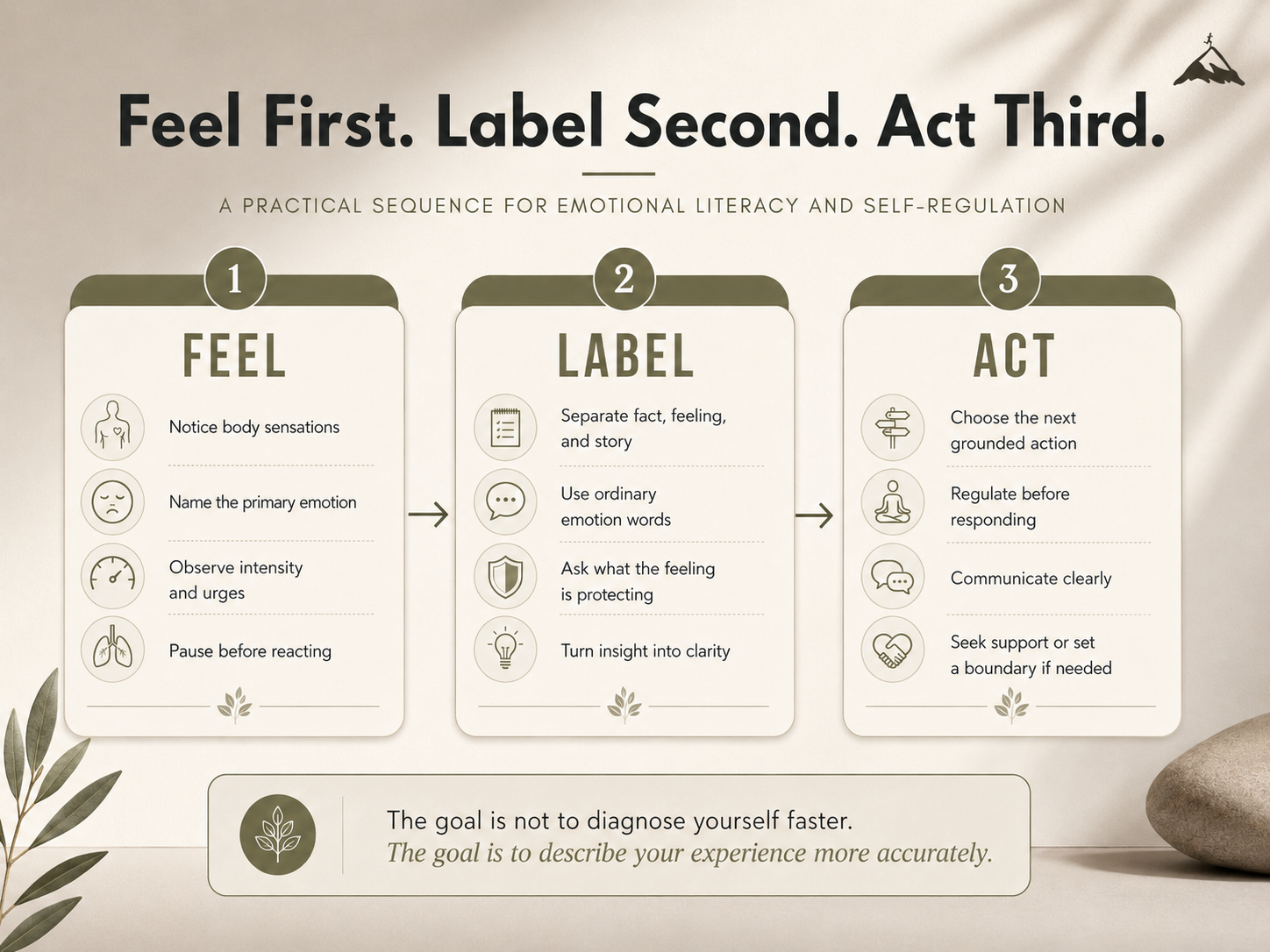
If you tend to overthink, over-explain, self-diagnose, shut down, people-please, intellectualise, spiral or turn one feeling into a complete personality analysis, try this.
1. Locate It Before You Explain It
Ask: where do I feel this in my body?
Chest? Throat? Jaw? Stomach? Shoulders? Hands? Forehead?
Does it feel tight, hot, heavy, numb, buzzing, frozen, restless, collapsed, sharp or flooded?
The body often knows you are activated before the mind has built its explanation. Sometimes the body says danger when the present moment is uncomfortable but not dangerous. Sometimes it says danger because something old has been touched. Sometimes it says danger because something genuinely is wrong.
The first job is not to obey it or dismiss it.
The first job is to notice it.
Presence is not pretending to be calm. It is the moment you stop sprinting away from the feeling and actually meet it where it is.
2. Name the Emotion in Ordinary Language
Before you say, “This is my trauma response,” try a simpler sentence.
I feel scared.
I feel ashamed.
I feel unwanted.
I feel powerless.
I feel angry.
I feel confused.
I feel lonely.
I feel exposed.
Ordinary words are not less intelligent. Sometimes they are more honest.
“I have abandonment trauma” can feel easier than “I am scared you do not want me.”
“That was triggering” can feel easier than “I felt embarrassed and small.”
“They are toxic” can feel easier than “I do not know how to protect myself around this person.”
The simple sentence is often where the work begins.
3. Separate Fact, Feeling and Story
Fact: what actually happened?
Feeling: what did I feel?
Story: what meaning did my mind add?
If someone cancels plans, the fact is: they cancelled plans.
The feeling might be disappointment, embarrassment, loneliness or anger.
The story might be: “I do not matter. People always leave. I am stupid for getting excited. They do not respect me.”
That story might contain information. It might also contain history.
Once you separate it from the fact, you get space.
You can ask: is this true? Is this old? Is this a pattern? Do I need to communicate? Do I need to soothe? Do I need to stop tolerating this?
Without that separation, emotional intensity becomes proof.
And emotional intensity is real, but it is not always complete.
4. Ask What the Feeling Is Protecting
This is what I mean by sitting in the mud.
Not wallowing. Not making pain your whole personality. Not setting up camp in the swamp and calling it healing.
I mean stop sprinting to the nearest explanation just because the feeling is uncomfortable.
Ask: what is this feeling trying to protect?
Anger may be protecting dignity.
Anxiety may be protecting certainty.
Shame may be protecting belonging.
Numbness may be protecting you from overload.
Jealousy may be protecting significance.
Resentment may be pointing toward a boundary you have not honoured.
Control may be trying to protect you from helplessness.
People-pleasing may be trying to protect connection.
Avoidance may be trying to protect you from failure, rejection or disappointment.
This does not mean the feeling is always right. It means the feeling has information.
You can listen without handing it the keys to the car.
5. Choose the Next Grounded Behaviour
This is the part that turns insight into integration.
Ask: what is the next honest action?
Not the perfect action. Not the most impressive action. The grounded one.
Maybe it is waiting before you reply.
Maybe it is sending a clearer message.
Maybe it is apologising.
Maybe it is asking for reassurance directly instead of testing someone.
Maybe it is not checking their social media.
Maybe it is eating something and sleeping before making a life decision.
Maybe it is calling a friend instead of isolating.
Maybe it is booking therapy because this pattern is bigger than a journal entry.
Maybe it is setting a boundary and deciding what you will do if it is crossed.
Maybe it is admitting, “I am not actually confused. I just do not like the answer.”
Maybe it is admitting, “I am not being patient. I am avoiding a conversation.”
Maybe it is admitting, “I keep calling this toxic, but I am still participating in the same dynamic.”
That is where many people get stuck.
They understand themselves, but nothing changes.
The work is not just knowing why you do it. The work is noticing the moment it happens and choosing something slightly different.
That is self-trust in motion.
Use the Label as a Hypothesis, Not a Verdict
Once you have made contact, the label can help.
After you have noticed the body, named the emotion, separated fact from story, understood the protective function and chosen the next grounded behaviour, then yes, maybe you can say:

This looks like an attachment pattern.
This might be a trauma response.
This is a boundary issue.
This resembles burnout.
This is grief.
This is something I need proper support with.
At that point, the label is not a verdict. It is a working hypothesis.
A verdict says, “I know exactly what this is, and I do not have to look any further.”
A working hypothesis says, “This might help me understand what is happening, but I am still willing to stay curious.”
That curiosity is the difference between growth and identity glue.
A label can explain the door you keep walking through.
It does not have to become the house you live in.
What Actually Changes When You Stop Labelling Too Quickly?
When you stop reaching for the label too early, the change is not abstract. It shows up in the ordinary moments where most people lose contact with themselves.
It shows up in the pause before you send the defensive message. It shows up when anger becomes information instead of ammunition. It shows up when anxiety becomes something you can listen to without letting it run the whole room. It shows up when shame no longer sends you straight into hiding, overexplaining or self-attack. It shows up when a boundary becomes less about controlling another person and more about choosing what you will participate in, what you will no longer tolerate, and what action you will take if the same pattern continues.
This is where therapy language becomes useful again, because it is no longer being used to decorate the pattern. It is being used to interrupt it.
Mindfulness and psychological flexibility are relevant here because both are concerned with the space between what happens inside you and what you do next.
Mindfulness-based interventions have been associated with reductions in emotional dysregulation, while Acceptance and Commitment Therapy research continues to point to psychological flexibility as a key process in mental health: the capacity to notice thoughts, feelings and bodily responses while still choosing behaviour that is aligned with values (Sharma et al., 2025; Zou et al., 2025).
In plain terms, the goal is not to become someone who never feels activated. The goal is to notice activation without automatically handing it the steering wheel.
That is the difference between insight and integration. Insight says, “I know why I do this.” Integration says, “I noticed myself doing it, and this time I chose something different.” The first can be helpful. The second is where life actually starts to shift.
The Point Is Not to Sound Healed

Therapy language is not the problem. Using it to bypass contact is.
Use trauma language if it helps you understand trauma. Use attachment language if it helps you understand attachment. Use boundary language if it helps you protect your wellbeing. Use nervous system language if it helps you regulate and reconnect. These words can be incredibly useful when they bring you closer to truth, closer to yourself, and closer to better action.
But if the label makes you more defended, more helpless, more superior, more avoidant or more stuck, it is worth pausing. Sometimes the next step is not a bigger psychological explanation. Sometimes it is a more honest sentence: “I feel hurt.” “I feel scared.” “I feel ashamed.” “I need support.” “I need space.” “I need to repair.” “I need to leave.” “I do not know yet.”
There is a lot of maturity in “I do not know yet.” There is also a lot of strength in being able to feel something without instantly turning it into a whole identity.
You do not need to throw away the labels. Just stop using them before you have met the feeling. Before the label, locate it. Before the label, name the emotion. Before the label, separate fact from story. Before the label, ask what the feeling is protecting. Before the label, choose the next grounded behaviour. Then, if a psychological concept helps, use it.
Healing is not about sounding more fluent in the language of therapy. It is about becoming more able to live, relate, choose, grieve, repair, protect yourself and move through life with less distortion. Sometimes the most healing sentence is not the most clinical one. Sometimes it is the first true thing you can finally say without running away from it.
If you are noticing these patterns in yourself and want support to move from insight into practical change, I work with adults online through counselling, psychotherapy-informed support and performance coaching, especially around anxiety, burnout, overthinking, emotional regulation, self-trust, life transitions and pressure. You can learn more about Becoming On Point or book a session with me.
References
Ariely, Y., et al. (2026). Affect labeling and reappraisal as an emotion regulation strategy. Affective Science.
Australian Institute of Family Studies. (2026). Intimate partner relationship breakdown and the risk of suicidal thoughts and behaviours in men. Ten to Men Research Snapshot.
Healthdirect Australia. (2026). Mental health helplines.
Isern-Mas, C., & Almagro, M. (2025). Unmasking therapy-speak. Theoretical Medicine and Bioethics.
Lieberman, M. D., Eisenberger, N. I., Crockett, M. J., Tom, S. M., Pfeifer, J. H., & Way, B. M. (2007). Putting feelings into words: Affect labeling disrupts amygdala activity in response to affective stimuli. Psychological Science, 18(5), 421–428.
Nazari, A., et al. (2023). The effect of web-based educational interventions on mental health literacy, stigma, and help-seeking intentions/attitudes in young people: A systematic review and meta-analysis. BMC Psychiatry.
Ozomaro, B., et al. (2025). Emotional granularity in health and psychopathology: A scoping review. Journal of Psychiatric Research, 190, 277–295.
Sharma, N., Agrawal, M., Rushi, Ayyub, S., & Rai, D. (2025). Mindfulness-based interventions for emotional dysregulation in adolescents: A systematic review. Annals of Neurosciences.
Sun, G., Wang, C., & Zhang, J. (2025). Effectiveness of mental health literacy interventions for adolescents: A systematic review and meta-analysis. SAGE Open, 15(1).
Zou, Y., et al. (2025). Effects of acceptance and commitment therapy on negative emotions, automatic thoughts and psychological flexibility for depression and its acceptability: A meta-analysis. BMC Psychiatry.
