The Real Reason You Feel Lost Might Not Be a Lack of Purpose

You do not need more answers. You need orientation.
There is a particular kind of exhaustion that comes from having too many options and not enough internal direction.
It is not the dramatic kind of lost where you quit everything, move countries, shave your head and announce a rebirth on Instagram. Sometimes it is quieter than that. You keep functioning. You answer messages. You go to work. You keep doing the things that make you look capable from the outside. But internally, every decision has started to feel heavier than it should.
Should I stay or leave? Push harder or rest? Trust this feeling or challenge it? Keep going or let go? Is this fear, intuition, avoidance, growth, burnout, self-sabotage, alignment, trauma, discipline or denial?
Modern life gives us endless maps. Podcasts, psychology reels, AI answers, productivity systems, nervous system hacks, coaching frameworks, spiritual language, relationship advice, career advice and the constant suggestion that the “right” life is just one better decision away. Yet many people do not feel clearer. They feel more fragmented.
This is what I would call an orientation crisis.

I explore this further in the full YouTube video, including why you may still feel lost and how to reconnect with your inner compass.
The problem is not always that people lack motivation, discipline or insight. Often, they are overloaded with insight and under-supported in knowing what actually matters. An answer tells you what to do. Orientation helps you know why one answer matters more than another.
That distinction is important, especially in counselling, psychotherapy and performance coaching, because “finding your purpose” is often sold as the solution. Find your why. Find your passion. Find your calling. Find your ikigai. Find the one clean sentence that explains why you exist.
It sounds helpful until it becomes another thing to fail at.
Purpose is not a slogan. It is a system of direction.

In psychological research, purpose in life is usually understood as a sense of direction, valued goals and meaningful engagement rather than a mystical life assignment.
A recent scoping review by Fang, Allan and Dickson (2024) found that purpose in life is associated with a broad range of cognitive and affective mechanisms, including agency, hope, self-efficacy, emotional regulation, self-worth, autonomy, coping, self-compassion and positive affect.
Their review also makes an important point that often gets lost online: the research is promising, but much of it is still correlational, and we need more longitudinal and intervention studies before claiming that purpose directly causes all these benefits.
That caution matters because purpose is not a cure-all, and it is not a replacement for therapy, rest, medication, financial stability, community, trauma support or practical problem-solving. But the research does suggest that a stronger sense of meaning and direction is linked with better psychological functioning, lower distress and more adaptive coping.

A useful way to think about purpose is not as a destination, but as a filter. It helps the mind organise relevance. When you do not have a hierarchy of values, everything starts competing for the same amount of emotional energy. Every opportunity, rejection, comment, message, possible future and imagined mistake can feel equally important.
Knowing your why does not remove uncertainty. It reduces the amount of internal negotiation required to move through uncertainty.
This is where purpose becomes less fluffy and more practical. A person with a values-based orientation may still feel anxious, disappointed or unsure, but they have something to return to. They can ask, “Which action is more aligned with the person I am trying to become?” rather than, “Which option guarantees that I will never regret anything?”
That shift matters because the second question is impossible to answer.
Why purpose can calm the nervous system without becoming toxic positivity

The phrase “nervous system regulation” gets thrown around so much now that it can start to lose meaning. Still, there is a serious point underneath it. When someone is caught in chronic uncertainty, overthinking or internal conflict, the body often responds as if it is under threat. The mind starts scanning, rehearsing, predicting and trying to find certainty before acting.
Meaning and psychological flexibility may help interrupt that loop. In a 2024 study of teachers, Yildirim, Dilekçi and Manap found that meaning in life and psychological flexibility partially mediated the relationship between occupational stress and outcomes including job satisfaction, job performance and psychological distress. In simpler terms, stress still mattered, but people with greater meaning and flexibility seemed better able to maintain functioning and mental health under pressure.
This is not proof that purpose makes people immune to stress. It suggests something more nuanced and more useful: meaning may change the way stress is metabolised.
That fits with what I often see in performance and counselling spaces. People can tolerate extraordinary effort when the effort feels connected to something real. In martial arts, hard training can feel clarifying when it is connected to mastery, courage, discipline or self-respect. The same physical intensity can feel completely different when it is driven by shame, panic or the need to prove you are not falling behind.
The body does not only respond to effort. It responds to the meaning of the effort.
That is why two people can be equally busy, but one feels stretched in a meaningful direction while the other feels hollowed out. The difference is not always workload. Sometimes it is congruence.
The hidden cost of living out of alignment

A lot of anxiety is not simply fear of the future. Sometimes it is the body recognising contradiction.
Your mouth says yes while your body says no.
Your calendar says this matters while your nervous system feels nothing but dread. Your identity says keep going, but your values are quietly asking for a different life. The longer someone lives inside that split, the more likely they are to experience overthinking, resentment, decision paralysis, emotional fatigue and a strange sense of being disconnected from themselves.
This is why “finding your purpose” can be the wrong starting point. The better question may be: where am I living in contradiction?
In Acceptance and Commitment Therapy, the focus is not on deleting difficult thoughts or forcing a positive mindset. ACT works with psychological flexibility: the capacity to stay present, make room for internal experience, unhook from unhelpful thoughts, clarify values and take committed action (Hayes, Strosahl, & Wilson, 2012). This is why ACT is so relevant to purpose. It does not ask people to wait until they feel confident. It asks them to move in the direction of what matters while making space for discomfort.
That is very different from motivational culture, which often implies that purpose should feel inspiring all the time.
Real purpose does not always feel inspiring. Sometimes it feels inconvenient. Sometimes it asks you to tell the truth, make the hard call, stop performing, disappoint someone, leave a familiar role, rest before you are forced to, or begin again without applause.
Letting go is not giving up. It is de-allocation.
Letting go is one of those phrases that can become almost useless because it has been softened to death. People say it as though it means becoming peaceful, detached and untouched by reality.
In practice, letting go is often less pretty and more active.
Letting go is withdrawing attention, identity investment, emotional energy and behavioural effort from something that can no longer return what you are trying to get from it. It is not the absence of care. It is the removal of unnecessary force.
You can care deeply and still stop gripping. You can grieve something and still stop negotiating with its ending. You can honour an old dream and still admit that the form it took no longer fits who you are becoming.
This is especially important for high-functioning adults, athletes, helpers, professionals and people who have built their identity around being strong. Sometimes the hardest thing to let go of is not a person, job or goal. It is the version of yourself that survived by never needing anything, never stopping, never failing publicly and never asking whether the path still fits.
I know this from martial arts as much as from counselling. There is a kind of discipline that sharpens you, and there is a kind that slowly turns into self-abandonment wearing a respectable outfit. Fighters learn very quickly that tension wastes energy. If you grip everywhere, you move badly. You gas out. You cannot read what is happening because your whole system is busy trying to force control.

The same thing happens psychologically. When you grip an old identity too tightly, you lose responsiveness. You cannot adapt because adaptation feels like betrayal.
Purpose becomes dangerous when it fuses with identity
Purpose is helpful when it gives direction. It becomes dangerous when it becomes identity fusion.
“I am the successful one.”“I am the strong one.”“I am the useful one.”“I am the disciplined one.”“I am the healer.”“I am the person who never gives up.”
These identities can look admirable from the outside, but they can become psychological cages. When purpose fuses with identity, change feels like failure. Rest feels like weakness. Letting go feels like becoming no one.
This is where Eastern and Western frameworks can speak to each other without being collapsed into the same thing. Buddhist non-attachment is often misunderstood as not caring, when it is more accurately about reducing clinging and the suffering created by grasping. Taoist ideas such as wu wei are sometimes translated as effortless action, although that can sound too passive in English. A more useful interpretation is action without unnecessary force. Meanwhile, existential psychology and Viktor Frankl’s logo-therapy emphasise meaning, responsibility and the human capacity to choose one’s stance amid suffering (Frankl, 2006).
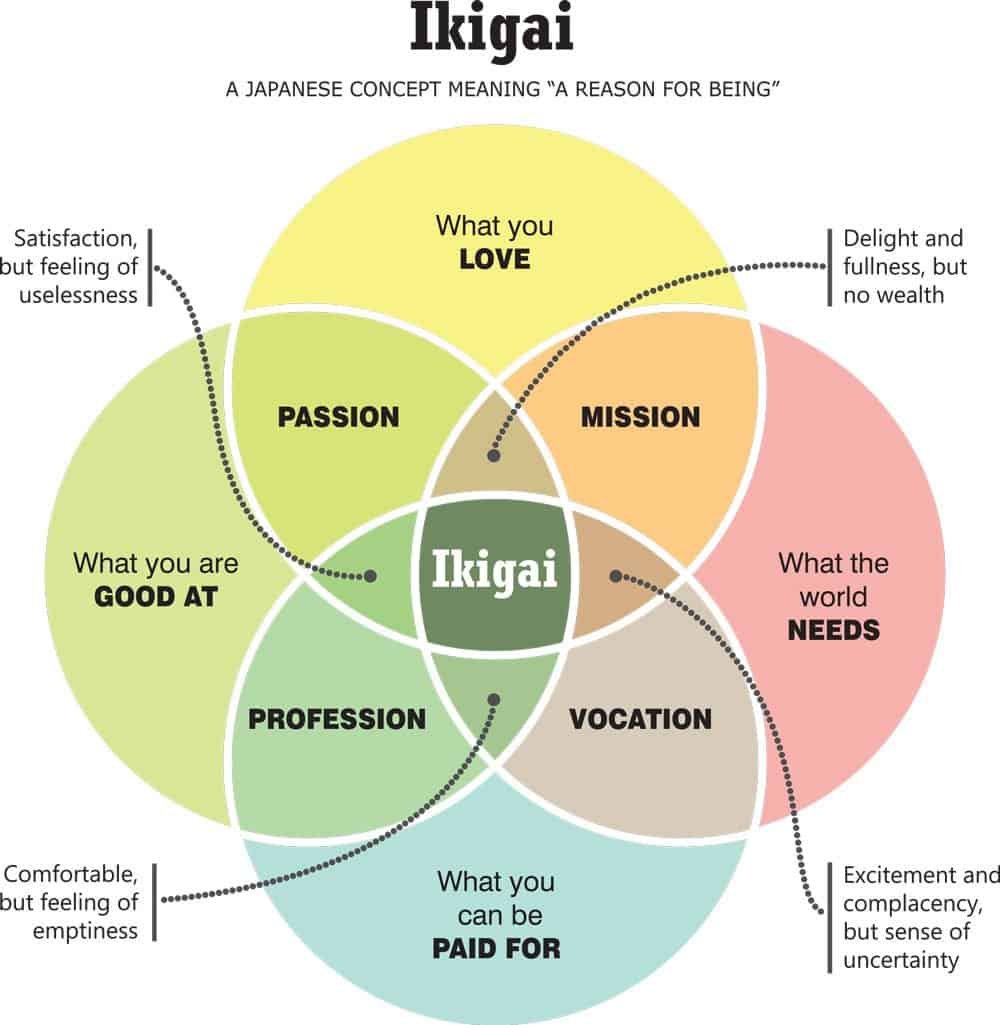
Ikigai is also worth treating carefully. In Western wellness culture, it is often reduced to a neat Venn diagram of what you love, what you are good at, what the world needs and what you can be paid for. That diagram is popular, but it is not the full Japanese concept. Research on ikigai tends to frame it more broadly as a reason for living, a source of motivation, fulfilment and life value, rather than a perfect career formula (Kumano, 2018; Okuzono et al., 2022).
The overlap across these traditions is not “find the one perfect life path.” It is much more interesting than that.
Suffering increases when we cling to forms that can no longer hold meaning. Flexibility increases when we can return to values without demanding that life look exactly the way we expected.
Flow: the performance version of letting go

The performance world offers another way into this. Flow states are often described as complete absorption in a task where challenge and skill meet. Recent neuroscience discussions suggest that flow may involve dynamic interaction between the default mode network, which is often associated with self-referential thought, and the executive control network, which supports goal-directed attention and cognitive control (Barnett & Vasiu, 2026).
This is fascinating because flow is not achieved by overthinking yourself into excellence. In many cases, performance improves when excessive self-monitoring quietens and attention becomes organised around the task. Anyone who has competed, coached, performed or created under pressure knows this difference. There is a point where trying harder becomes interference.
That is one of the most overlooked parts of letting go. It can improve action.
Letting go is not always a retreat from life. Sometimes it is what allows someone to respond cleanly. To stop rehearsing the mistake before it happens. To stop narrating themselves while they are trying to perform. To stop turning every action into evidence of their worth.
This matters beyond sport. In work, relationships, therapy and life transitions, people often become stuck because they are trying to think their way into total certainty before taking the next step. But self-trust is not certainty. Self-trust is the ability to stay in relationship with yourself while reality unfolds.

Purpose is practised, not discovered once
The most useful question may not be “What is my purpose?” but “What keeps mattering, even when the old version of my life changes?”
That question is less glamorous, but more durable. It leaves room for grief, burnout, endings, career changes, changing bodies, changing relationships and identity reconstruction. It allows purpose to evolve without treating every change as a personal collapse.
Purpose is often built through repeated contact with what matters. You try something. You notice what gives you clean energy rather than frantic energy. You notice what kind of tiredness feels meaningful and what kind feels like self-erasure. You notice where effort makes you more honest, not just more impressive. You notice where your values and behaviour actually meet.
This is where counselling and coaching can be powerful, especially when they do not turn purpose into pressure. The work is not to manufacture a shiny life mission. It is to help someone hear themselves again underneath the noise. To separate values from fear. To distinguish avoidance from genuine release. To build enough emotional regulation that a person can make choices without needing perfect certainty first.
For many people, the next step is not a grand reinvention. It is one aligned action.
One conversation. One boundary. One honest admission. One application. One ending. One return to training. One decision to stop outsourcing your life to every voice except your own.
Purpose does not need to arrive as a lightning strike. Sometimes it returns as a quieter form of self-respect.

A better way to ask the question
Instead of asking, “What is my purpose?” try asking:
What am I still trying to get from something that cannot give it to me?
Where am I using control to avoid grief?
What part of my identity am I afraid to update?
What kind of effort makes me feel more like myself?
What keeps mattering, even when the form changes?
What would I choose if I trusted myself to recover from an imperfect decision?
These questions do not give instant answers. That is the point. They are designed to rebuild orientation rather than chase reassurance.
The real work is not finding one perfect why and gripping it forever. The real work is learning how to move honestly, release what no longer fits, and stay connected to what matters without turning purpose into another cage.
You may not need a completely new life. You may need a clearer relationship with the life that is asking to be lived through you now.
Support for anxiety, self-trust and life direction
Becoming On Point offers online counselling, psychotherapy-informed support and performance coaching for adults navigating anxiety, burnout, overthinking, emotional regulation, life transitions, self-trust and pressure. Sessions are designed to help you build clarity without forcing certainty, and to reconnect with values-based action in a way that feels grounded, practical and human.
If you are feeling lost, stuck or pulled in too many directions, the starting point may not be finding the perfect answer. It may be learning how to hear yourself again.
References
Barnett, K., & Vasiu, F. (2026). Enhanced functional connectivity between the default mode network and executive control network during flow states may facilitate creativity and emotional regulation, and may improve health outcomes. Frontiers in Behavioral Neuroscience, 19, Article 1690499.https://doi.org/10.3389/fnbeh.2025.1690499
Fang, L., Allan, A., & Dickson, J. M. (2024). Purpose in life and associated cognitive and affective mechanisms. Journal of Happiness Studies, 25, Article 63.https://doi.org/10.1007/s10902-024-00771-6
Frankl, V. E. (2006). Man’s search for meaning. Beacon Press. Original work published 1946.
Hayes, S. C., Strosahl, K. D., & Wilson, K. G. (2012). Acceptance and commitment therapy: The process and practice of mindful change (2nd ed.). Guilford Press.
Kumano, M. (2018). On the concept of well-being in Japan: Feeling shiawase as hedonic well-being and feeling ikigai as eudaimonic well-being. Applied Research in Quality of Life, 13, 419–433.https://doi.org/10.1007/s11482-017-9532-9
Okuzono, S. S., Shiba, K., Kim, E. S., Shirai, K., Kondo, N., Fujiwara, T., Kondo, K., Lomas, T., & Trudel-Fitzgerald, C. (2022). Ikigai and subsequent health and wellbeing among Japanese older adults: Longitudinal outcome-wide analysis. The Lancet Regional Health – Western Pacific, 21, Article 100391.https://doi.org/10.1016/j.lanwpc.2022.100391
Yildirim, M., Dilekçi, Ü., & Manap, A. (2024). Mediating roles of meaning in life and psychological flexibility in the relationships between occupational stress and job satisfaction, job performance, and psychological distress in teachers. Frontiers in Psychology, 15, Article 1349726.https://doi.org/10.3389/fpsyg.2024.1349726
